• All four skills are compulsory: Listening, Reading, Writing and Speaking.
• Each skill is reported separately, so your level can differ from one skill to another.
• TCF result certificates are valid for two years.
• Question difficulty progresses from easier tasks toward more demanding ones.
• For Canadian immigration purposes, TCF Canada results are converted to NCLC levels.
What does it not test?
TCF Canada is not a general-knowledge test about Canada and it does not test immigration law. Its
purpose is to measure how effectively you understand and use French.
The exam at a glance
Four compulsory skills - total test time: 2 hours 47 minutes
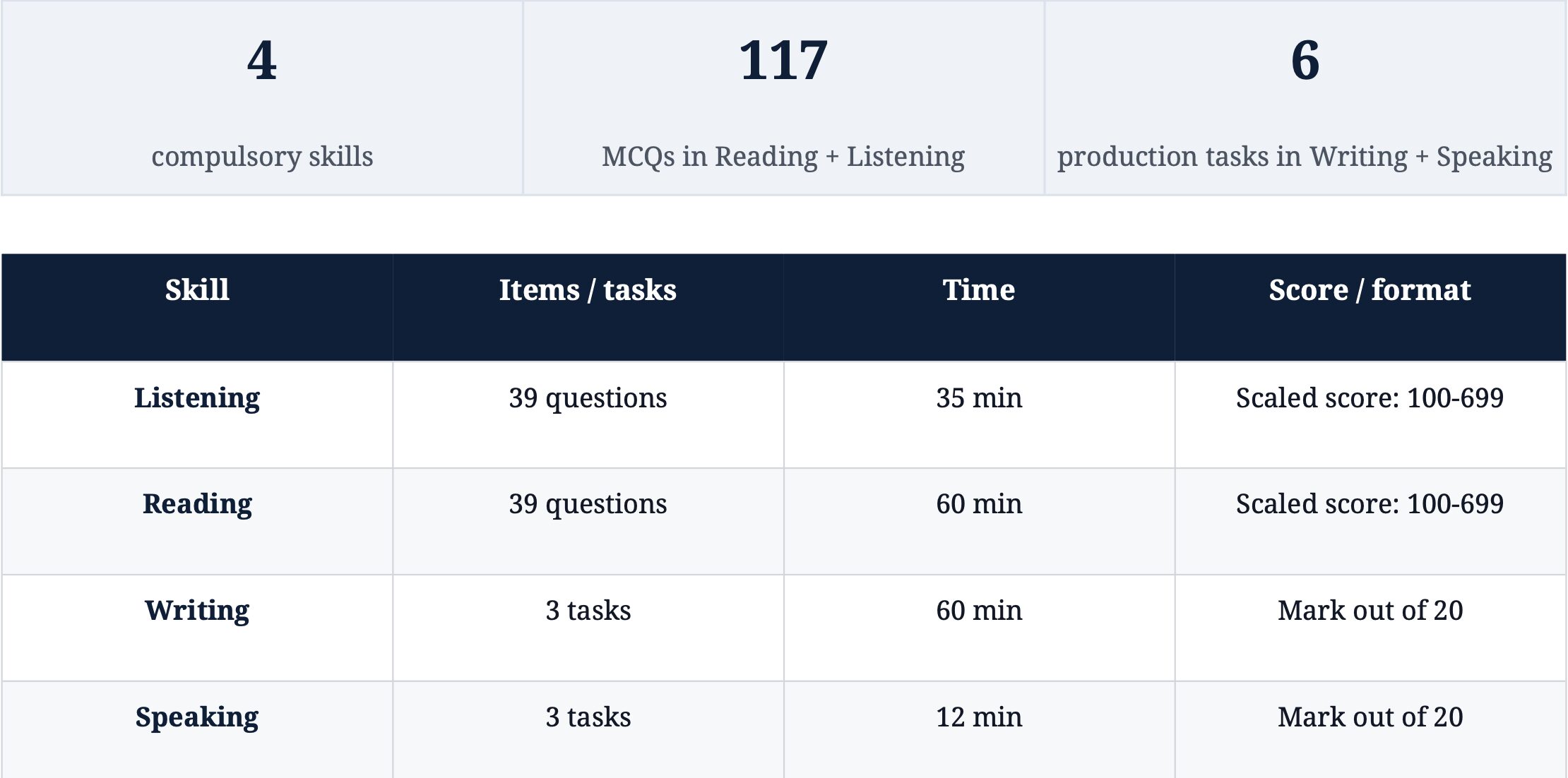
The stated total includes the four test components. The two-minute preparation time for Speaking Task 2 isincluded within the 12-minute speaking test.
Why structure matters
A strong level of French is essential, but TCF performance also depends on format awareness, time
control, option discrimination and familiarity with real-test pressure.
Listening | Compréhension orale
39 questions - 35 minutes - four options per question - one correct answer
Listening requires you to capture the meaning of spoken French in real time. Each recording is
played once, and the question is presented after the audio, so concentration, fast situational
inference and disciplined option elimination matter.
Typical item families
- Very short everyday situations, sometimes linked to an image, where you identify the matching utterance or response.
- A short spoken question followed by four possible answers; you choose the most natural and relevant one.
- Everyday dialogues involving shopping, appointments, transport, services, work, phone calls or planning.
- Short messages and announcements requiring you to identify the main information, time, place, purpose or instruction.
- Interviews, professional exchanges and media-style recordings with more information to process.
- More advanced spoken texts where you must identify stance, intention, argument, implication or a precise detail.
Why structure matters
A strong level of French is essential, but TCF performance also depends on format awareness, time
control, option discrimination and familiarity with real-test pressure.
Reading | Compréhension écrite
39 questions - 60 minutes - four options per question - one correct answer
Reading moves from short practical texts to more complex material. You may need to identify explicit information, communicative purpose, logical relationships and, at higher levels, implicit meaning.
Common text and question types
- Signs, notices, timetables, advertisements, short messages and other practical information.
- Personal or administrative emails, letters and messages with a clear communicative purpose.
- Everyday and workplace texts about services, activities, events and professional situations.
- Articles and reports that present information, explain an issue or express a position.
- Longer, denser texts containing abstract vocabulary, argumentation or specialized information.
- Questions on main idea, detail, cause and effect, author purpose, conclusion or implied meaning.
Managing the 60 minutes
Do not let one difficult passage consume the time needed for several other questions. Secure accessible points first, then return to the most demanding items if time remains.
Writing | Expression écrite
3 tasks - 60 minutes - mark out of 20
Writing is not a grammar-only test. Evaluators look at whether you complete the communicative task, organize ideas coherently, use appropriate vocabulary and structures, and adapt your language to the situation.
Task 1 | 60-120 words
Write a message that describes, recounts and/or explains something. The recipient and situation are specified in the prompt.
Task 2 | 120-150 words
Write a text such as an article, letter or note to report an experience or tell a story, adding comments, opinions or arguments as required by the objective.
Task 3 | 120-180 words
Compare two viewpoints on a social issue and then present your own position in a clear, organized way.
Three costly errors: going off topic, missing the required word range, or leaving a task incomplete. Memorized scripts can also seriously damage the evaluation.
Speaking | Expression orale
3 tasks - 12 minutes - individual interview - mark out of 20
Task 1 | 2 minutes | no preparation
Write a message that describes, recounts and/or explains something. The recipient and situation are specified in the prompt.
Task 2 | 2 minutes preparation + 3 min 30 interaction
You must obtain information from the examiner in an everyday situation. Your role and the examiner’s role are given. Accurate questions and sustained interaction are central.
Task 3 | 4 min 30 | no preparation
You express and develop a viewpoint on a topic in a continuous, structured and convincing way, with reasons, examples and answers to follow-up questions when needed.
What is evaluated
Range and control of vocabulary, grammar, pronunciation and fluency, together with interaction, coherence, development of ideas and sociolinguistic appropriateness.
How is TCF Canada scored?
Listening and Reading use scaled scores; Speaking and Writing use marks out of 20
For the two multiple-choice skills, correct responses are converted into a scaled score from 100 to 699. Item difficulty is taken into account, so the final score is not calculated by simply multiplying the number of correct answers by a fixed number of points.
CEFR score bands for the MCQ skills
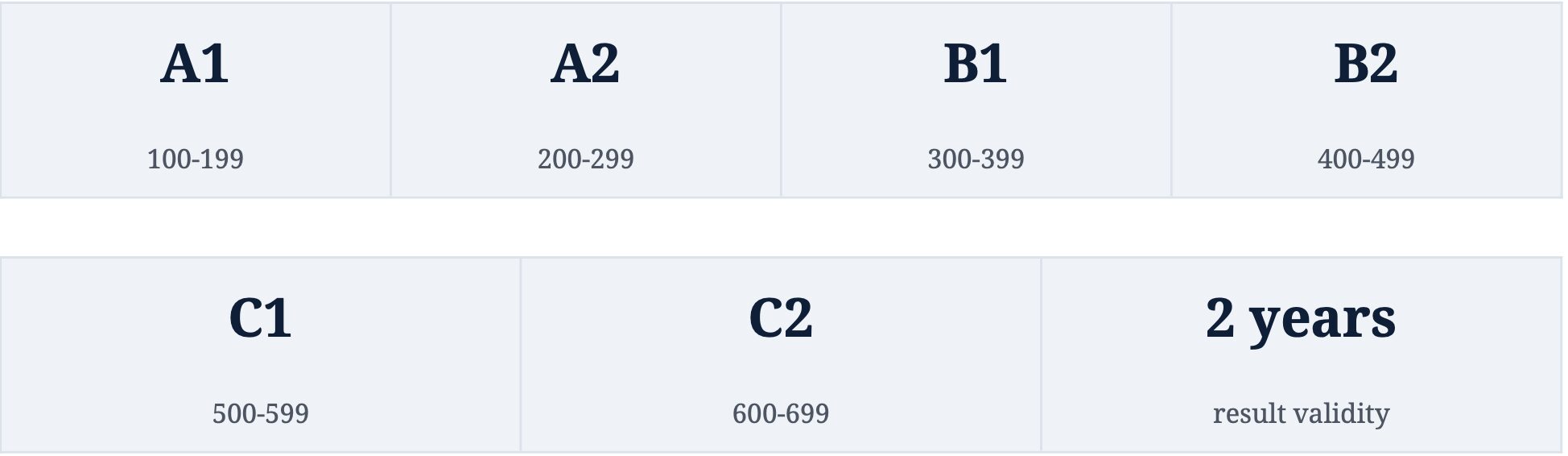
Speaking and Writing are reported as marks out of 20. As a broad CEFR interpretation, 10-13 corresponds to B2, 14-17 to C1 and 18-20 to C2.
For Canadian immigration
What usually matters is the NCLC level reached in each individual skill. The next page shows the official TCF Canada-to-NCLC conversion for levels 4 through 10+.
TCF Canada to NCLC conversion
Reference table for all four skills - NCLC 4 through 10+
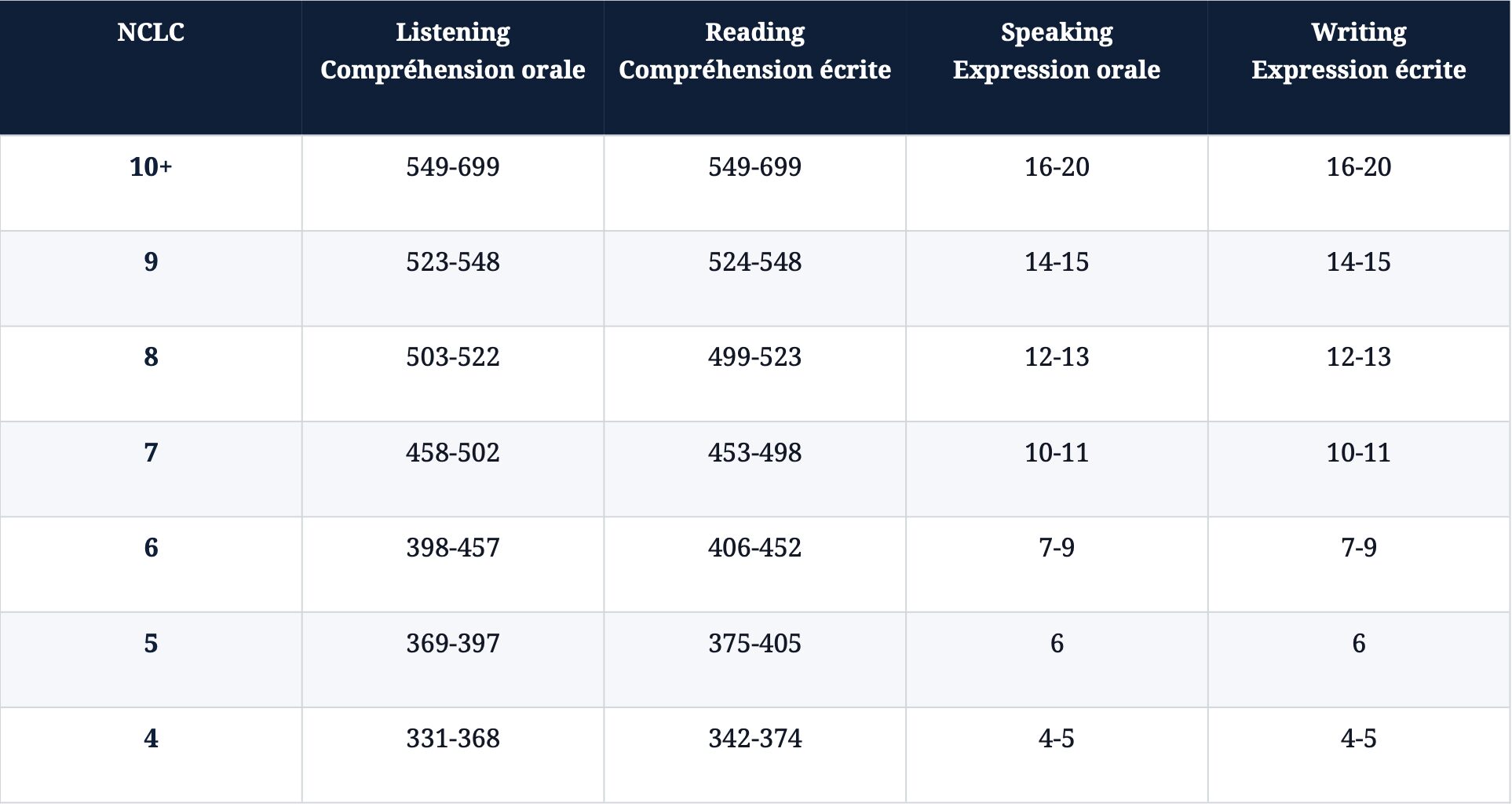
Example: NCLC 7 requires at least 458 in Listening, 453 in Reading, and 10/20 in both Speaking and Writing.
Important
This table only converts test results to NCLC. The NCLC threshold you personally need depends on the immigration program, occupation, stream or application and should be checked against the official requirements for that program.
Test-day essentials
A few operational rules can prevent avoidable problems.
- TCF Canada registration requires identity information, including your passport number.
- Bring valid photo identification that meets your test centre’s requirements.
- Candidates are photographed on test day as part of identity verification procedures.
- Electronic devices, study aids, notes, dictionaries and recording equipment are not permitted during the test.
- Listening recordings are played once; there is no replay.
- When the test is delivered on computer, Speaking still takes place as an interview with an examiner.
- In Writing, complete all three tasks and respect the required word ranges.
For Canadian immigration
Confirm the date, time, venue, test delivery mode and required documents directly with your test centre. Centre instructions and official exam-day rules take priority.
How Académie Française Mehraban helps
A few operational rules can prevent avoidable problems.
Successful preparation requires more than vocabulary and grammar. Candidates also need to understand the mechanics of the test, timing pressure, distractor design and the performance expected in each skill.
- Targeted TCF Canada preparation across all four compulsory skills.
- Listening and Reading strategies for key-information detection, distractor elimination and time management.
- Writing preparation focused on task completion, organization, coherence, vocabulary and word-count control.
- Speaking practice for interaction, question formation, argumentation and spontaneous response development.
- Original AFM practice tests designed to approximate the format, progression and challenge of the real exam without using official or confidential test questions.
- Structured practice that helps candidates identify weak areas and convert them into a concrete study plan.
AFM principle
The goal is to simulate the experience and logic of the exam, not to copy official content. AFM practice materials are independently developed.
Practise Reading and Listening on the AFMwebsite
Move from scattered practice to exam-oriented training
Week 1 | Diagnose
Take one timed Reading test and one timed Listening test. Produce an initial Writing and Speaking sample to establish your baseline.
Week 2 | Technique and accuracy
Work on the question types where errors are most frequent. The priority is to reduce comprehension errors and improve decision quality.
Week 3 | Speed and time pressure
Make practice increasingly timed. In Writing, practise allocating time across three tasks; in Speaking, practise building responses quickly.
Week 4 | Simulation
Complete several exam-style sessions. After each one, do more than check the score: classify why each error happened and correct the underlying weakness.
The core cycle is: test - analyse - correct - retest. High test volume without error analysis usuallyproduces much less durable improvement.
Final candidate checklist
Before booking your test or starting your final review
- I know the NCLC level I need in each of the four skills for my objective.
- I can state the format and timing of all four TCF Canada sections without checking notes.
- I have completed several full Reading and Listening practice tests under real timing.
- I have a clear thinking structure for all three Writing tasks, but I do not rely on memorized scripts.
- In Speaking, I can develop an answer spontaneously and support it with reasons and examples.
- I track my recurring errors and have a specific practice method for each one.
- I have checked my test centre’s documents, schedule and test-day rules.